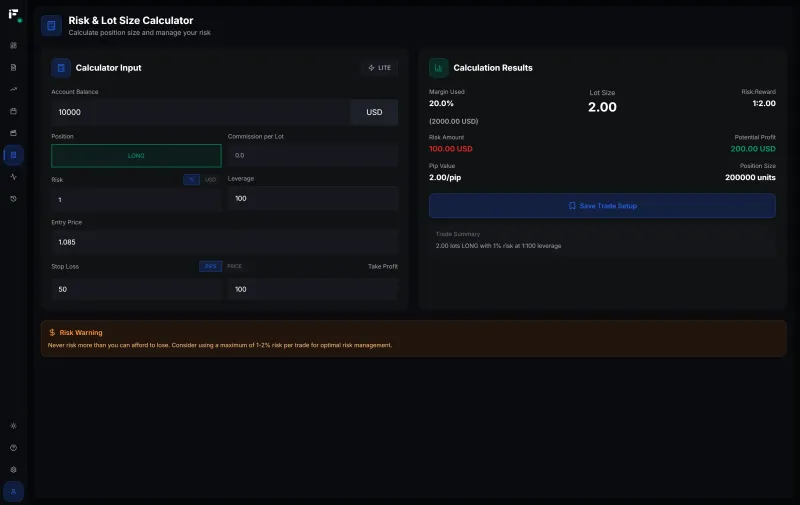
To calculate lot size in forex, divide the money you are willing to lose on the trade by the loss one standard lot would take at your stop: lot size = risk amount ÷ (stop distance in pips × pip value per 1.00 lot).
Risk amount = Account balance × Risk %
Lot size    = Risk amount ÷ (Stop distance in pips × Pip value per 1.00 lot)
The stop comes from the chart, the risk percentage from your plan, and the lot size is the output. The hard part is the denominator: what a pip is on the symbol you trade and what it is worth in your account currency. That is where real sizing errors come from, and most of them are off by a factor of ten. Below are the units, the pip-versus-point trap, five worked examples and the adjustments that turn the textbook answer into an order you can place.
What is a lot in forex?
A lot is the standard trade size unit. On a currency pair, 1.00 lot is 100,000 units of the base currency. Brokers let you trade fractions of it, and the fractions have names:
| Name | Lot size in MT5 | Units of base currency | Pip value on EUR/USD |
|---|---|---|---|
| Standard lot | 1.00 | 100,000 | $10.00 |
| Mini lot | 0.10 | 10,000 | $1.00 |
| Micro lot | 0.01 | 1,000 | $0.10 |
Pip value scales linearly: 0.37 lots on EUR/USD is $3.70 per pip. Other instruments use different contract sizes, so the same "1.00 lot" carries very different risk:
| Instrument | 1.00 lot | One pip | Value per pip per 1.00 lot |
|---|---|---|---|
| EUR/USD, GBP/USD | 100,000 units | 0.0001 | $10 |
| USD/JPY | 100,000 units | 0.01 | 1,000 JPY (about $6.67 at 150.00) |
| XAU/USD (gold) | 100 oz | 0.10 | $10, so a $1.00 move is $100 |
| XAG/USD (silver) | 5,000 oz | 0.01 | $50 |
| NAS100, US30 (CFD) | usually 1 × index | 1 point | usually $1 per point, broker-dependent |
What is the difference between a pip and a point?
A pip is the conventional unit traders quote stops in. A point is MT5's smallest price step for the symbol. They are not the same thing, and confusing them is the most common way to size a trade ten times too large or too small.
- 5-digit FX quotes. EUR/USD is quoted as 1.08452. The fifth decimal is the point (0.00001), the fourth is the pip (0.0001). So 1 pip = 10 points. A 25-pip stop shows in MT5 as 250 points.
- 3-digit JPY quotes. USD/JPY is quoted as 150.125. The point is 0.001, the pip is 0.01. Again, 1 pip = 10 points.
- Gold. XAU/USD is usually quoted with two decimals, such as 2,650.45. The MT5 point is 0.01, while the pip convention used here (and in the Fips calculators) is 0.10. A $4.00 stop is 400 points, 40 pips, and $4.00 of price.
The danger is that "pip" on gold has no single convention. Some traders call $0.01 a pip, some $0.10, some $1.00. If someone tells you to use a "40 pip stop" and means $40 of price, and you enter 40 into a calculator that treats a gold pip as $0.10, you size for a $4.00 stop and end up ten times too large. The fix is simple: convert the stop to a price distance first ($4.00, or 0.00250), then into pips using the table above.
How do you calculate lot size step by step?
- Decide the risk amount: balance × risk percentage.
- Measure the stop distance in price, then convert it to pips.
- Find the pip value per 1.00 lot in your account currency.
- Divide the risk amount by (pips × pip value).
- Round down to the broker's lot step.
If you prefer to work straight from MT5's symbol specification, the same formula in broker terms is:
Loss per 1.00 lot = (Stop distance in price ÷ Tick size) × Tick value
Lot size          = Risk amount ÷ Loss per 1.00 lot
For EUR/USD with a tick size of 0.00001 and a tick value of $1: a 0.00250 stop is 250 ticks × $1 = $250 per lot, which matches 25 pips × $10.
Example 1: EUR/USD, $10,000 account, 1% risk, 25-pip stop
EUR/USD has USD as the quote currency, so the pip value is a flat $10 per lot for a USD account.
- Risk amount: $10,000 × 0.01 = $100
- Loss per 1.00 lot at the stop: 25 pips × $10 = $250
- Lot size: $100 ÷ $250 = 0.40 lots
- Check: 0.40 × 25 × $10 = $100
The same account with a 50-pip stop would trade 0.20 lots. The dollar risk stays at $100; only the size moves. The EUR/USD calculator does this with your own balance and stop.
Example 2: USD/JPY with currency conversion
On USD/JPY the quote currency is yen, so one pip on 1.00 lot is 1,000 JPY. To size in dollars, convert at the current rate. This example assumes USD/JPY = 150.00; use the live rate when you trade.
- Account $10,000, risk 1%: $100
- Stop: 30 pips (0.30 of price)
- Pip value per lot in USD: 1,000 JPY ÷ 150.00 = $6.6667
- Loss per 1.00 lot: 30 × $6.6667 = $200.00
- Lot size: $100 ÷ $200 = 0.50 lots
You can also do it entirely in yen: $100 × 150 = 15,000 JPY of risk; 15,000 ÷ (30 × 1,000) = 0.50 lots. Same answer.
The rate matters. At an assumed 140.00, the pip value rises to 1,000 ÷ 140 = $7.1429, the loss per lot becomes $214.29, and the size falls to 0.4667, which you round down to 0.46 lots. Using a stale pip value of "$10 per pip" here would size you at 0.33 lots, a real but non-obvious error. The USD/JPY calculator applies the conversion for you.
Example 3: XAU/USD gold with a $4.00 stop
Gold is where most 10× errors happen, so work in dollars of price first.
- Account $10,000, risk 1%: $100
- Entry 2,650.00, stop 2,646.00: stop distance $4.00 = 40 pips (at $0.10 per pip) = 400 MT5 points
- Loss per 1.00 lot: a $1.00 move is $100, so $4.00 × $100 = $400 (or 40 pips × $10 = $400)
- Lot size: $100 ÷ $400 = 0.25 lots
- Check: 0.25 × $400 = $100
Now the error. If you read the $4.00 stop as "4 pips" and multiply by $10, you get a loss per lot of $40 and a size of 2.50 lots. At the stop, 2.50 lots loses 2.50 × $400 = $1,000, which is 10% of the account instead of 1%. If you go the other way and enter the 400 points as pips, you size at 0.025, round to 0.02 lots, and risk $80 instead of $100: wrong, but in the safe direction. The XAU/USD calculator accepts the stop as a price level or in pips, so you can enter the price and skip the convention question.
Example 4: NAS100 index CFD
Index CFDs have no universal contract size. Many brokers set 1.00 lot = 1 × the index, which makes one index point worth $1 per lot, but some use 10 × or 0.1 ×. Check the contract size in MT5 before you size anything: right-click the symbol in Market Watch, choose Specification, and read contract size, tick size, tick value, minimal volume and volume step.
Assume a contract size of 1, so $1 per index point per lot:
- Account $10,000, risk 1%: $100
- Stop: 50 index points
- Loss per 1.00 lot: 50 × $1 = $50
- Lot size: $100 ÷ $50 = 2.00 lots
On a broker where the contract size is 10, the same trade is $10 per point per lot: $100 ÷ (50 × $10) = 0.20 lots. On a 0.1 contract it would be 20.00 lots. The same chart, the same stop, a hundredfold range of correct sizes. Note also that NAS100 is often quoted with two decimals, so 50 index points can appear in MT5 as 5,000 points. US30 works the same way; confirm its specification separately rather than assuming it matches NAS100. The NAS100 calculator uses the common 1 × index contract; if your broker's specification differs, scale the result by the ratio.
Example 5: FTMO 2-Step $100K, sized against the daily loss limit
On a prop account, per-trade risk is only half the problem: your size also has to respect the firm's daily loss limit. The rules used here are for the FTMO Challenge 2-Step (Standard), checked against FTMO's official rules on 26 September 2026. Rules change, so confirm them on FTMO's page before you trade.
- Daily loss 5%: equity may not fall below the 00:00 CE(S)T balance minus 5% of initial capital. On $100,000 that is $5,000.
- Max loss 10%, static: equity may not fall below $90,000.
Both limits are measured on equity, so open losses count before you close anything.
Step 1: set a daily budget below the firm's limit. If you size each trade at 1% ($1,000), five losing trades in one day put equity at exactly the $95,000 floor, and spread, commission or slippage on the last one push you through it. A more workable plan is a personal daily stop at half the firm's limit, $2,500, and per-trade risk of 0.5%, $500. Five full losses then stop you for the day with $2,500 still between you and the breach.
Step 2: size the trade. EUR/USD, 20-pip stop:
- Loss per 1.00 lot: 20 × $10 = $200
- Lot size: $500 ÷ $200 = 2.50 lots
Step 3: re-check the remaining room before each trade. Suppose the day started at a $100,000 balance and you are already down $1,800. Room to FTMO's floor: $3,200. Room to your personal stop: $700. Per-trade risk of $500 still fits. After one more loss, the day is down $2,300 and only $200 remains to your own stop, so the next trade is either sized at $200 ÷ $200 = 1.00 lot or not taken.
Step 4: remember the floor that binds. The daily floor is 5% of initial capital below the day's starting balance, so a day starting at $102,000 has a floor of $97,000. But if the account has drifted down to a $93,000 balance, the daily floor would be $88,000 while the static max-loss floor is $90,000. The max loss binds first, and you have $3,000 of room, not $5,000. Also count open positions together: two 2.50-lot trades open at the same time put $1,000 at risk against the daily limit, not $500.
The FTMO calculator works through this sizing with FTMO's account sizes, and the guide to how prop firm daily drawdown is calculated explains the balance, higher-of and equity bases that different firms use.
How do you round lot size to your broker's lot step?
Always round down to the volume step, which is 0.01 on most forex and gold symbols. 0.4667 becomes 0.46, not 0.47. Rounding up adds risk you did not plan for; rounding down only trims it slightly.
The minimum lot is a separate constraint. A $500 account risking 1% ($5) on a 60-pip EUR/USD stop works out to $5 ÷ (60 × $10) = 0.0083 lots, which is below the 0.01 minimum. The smallest trade available, 0.01 lots, risks 0.01 × 60 × $10 = $6, or 1.2%. Your options are to accept that larger risk knowingly, find a tighter stop that the chart actually justifies, or skip the trade. Moving the stop just to make the size fit is the wrong option.
Should you add the spread to your stop distance?
Yes. A long position is opened at the ask and its stop is triggered on the bid, so the spread is part of the loss when the stop is hit. Shorts are the mirror image. Size with the stop distance plus the typical spread, plus slippage you expect at that time of day.
Using Example 1 with a 1-pip spread: 25 + 1 = 26 pips. $100 ÷ (26 × $10) = 0.3846, rounded down to 0.38 lots, and the full loss at the stop is 0.38 × 26 × $10 = $98.80.
Commission can be folded in the same way. As an example, a commission of $7 per lot round turn on EUR/USD equals 0.7 pips at $10 per pip. On a 10-pip scalp that is 7% of the stop distance, and ignoring it makes every loss slightly larger than planned.
How do you calculate lot size when your account is not in USD?
Convert either the risk amount or the pip value into the same currency. Take a EUR account of €10,000 risking 1%, €100, with a 25-pip stop on EUR/USD, and assume EUR/USD = 1.0800:
- Pip value per lot in EUR: $10 ÷ 1.0800 = €9.259
- Lot size: €100 ÷ (25 × €9.259) = 0.432, rounded down to 0.43 lots
- Check: 0.43 × 25 × €9.259 = €99.54
Or convert the risk: €100 × 1.0800 = $108; $108 ÷ (25 × $10) = 0.432. Same answer. The pip value calculator shows the pip value in your account currency.
What are the most common lot size mistakes?
- Using points as pips, or a different gold pip convention. The 10× error from Example 3. Convert to price distance first.
- Assuming $10 per pip on every pair. That only holds for USD-quoted pairs in a USD account. USD/JPY, crosses and non-USD accounts all need conversion.
- Assuming index contract sizes. Check the MT5 specification for every new broker and every new symbol.
- Rounding up, or ignoring spread and commission. Both make every loss slightly larger than planned.
- Sizing each trade in isolation. Three correlated positions (long EUR/USD, long GBP/USD and short USD/CHF, for example) at 1% each behave more like one 3% position.
- Choosing the lot size first and then placing the stop to fit it. The stop belongs where the trade idea is invalidated. The size follows.
How do losing streaks and drawdown change your lot size?
A per-trade risk that looks small becomes a real drawdown over a run of losses, and runs of losses are a normal part of trading any strategy.
If you recompute 1% from the current balance after each loss, ten consecutive losses take the account to 0.99^10 = 90.44% of where it started, a 9.56% drawdown. Getting back requires a gain of 10.57%. At 2% per trade, the same streak leaves 0.98^10 = 81.71%, an 18.29% drawdown, and a 22.39% gain is needed to recover. If you keep a fixed dollar risk instead of recomputing, ten losses at $100 cost exactly 10% of a $10,000 account.
For prop accounts this is direct arithmetic against the rules. On an FTMO 2-Step $100K, ten losses at a fixed $1,000 each reach the $10,000 maximum loss. Sizing from the current balance shrinks positions as the drawdown deepens, which buys extra trades before a limit is hit but slows recovery. The risk management guide covers fixed-fractional sizing, R-multiples and recovery in more depth.
Where does a trading journal fit in?
The formula assumes the stop you sized for is the loss you actually take. Your trade history tells you whether that is true: whether slippage on news, wider spreads at the open or a moved stop make your real losses larger than 1R. That is what a trading journal is for. Fips is in private beta with access by waitlist; it syncs MT4 and MT5 trades through the read-only investor password, connects other platforms through read-only access where the platform offers it, and imports the rest by CSV. The calculators, including the lot size calculator, work without an account.
Frequently asked questions
What lot size should I use on a $100 account?
At 1% risk, $100 allows $1 per trade. The smallest standard trade, 0.01 lots on EUR/USD, loses $0.10 per pip, so even a 20-pip stop risks $2, or 2% of the account. On very small accounts the broker's minimum lot, not your risk percentage, sets the floor on how much you risk.
What lot size should I use on a $1,000 account?
At 1% risk ($10) and a 20-pip stop on EUR/USD: $10 ÷ (20 × $10) = 0.05 lots. With a 40-pip stop it is 0.02 lots (0.025 rounded down). The answer always depends on the stop distance, which is why there is no single correct lot size for an account balance.
How do you calculate lot size for gold?
Measure the stop in dollars of price, then use $100 per $1.00 move per 1.00 lot. A $5.00 stop costs $500 per lot, so $100 of risk is 0.20 lots. Converting to "pips" is optional; working in price avoids the 10× convention error.
Is 1 pip always worth $10?
No. $10 per pip per 1.00 lot applies to pairs quoted in USD, such as EUR/USD and GBP/USD, in a USD account. USD/JPY is 1,000 JPY per pip, which varies in dollars with the exchange rate. Gold, silver and indices have their own contract sizes.
Should I size from balance or equity?
Most traders size from balance and risk a fixed percentage of it. If you already have open positions, sizing from equity, or subtracting the risk already open, is more conservative. On prop accounts the limits are measured on equity, so open losses count toward the daily and maximum loss whatever you size from.