
Forex Risk Management: The Complete 2025 Guide for Traders
Master the art of protecting your trading capital with proven risk management strategies, position sizing techniques, and professional trader mindset
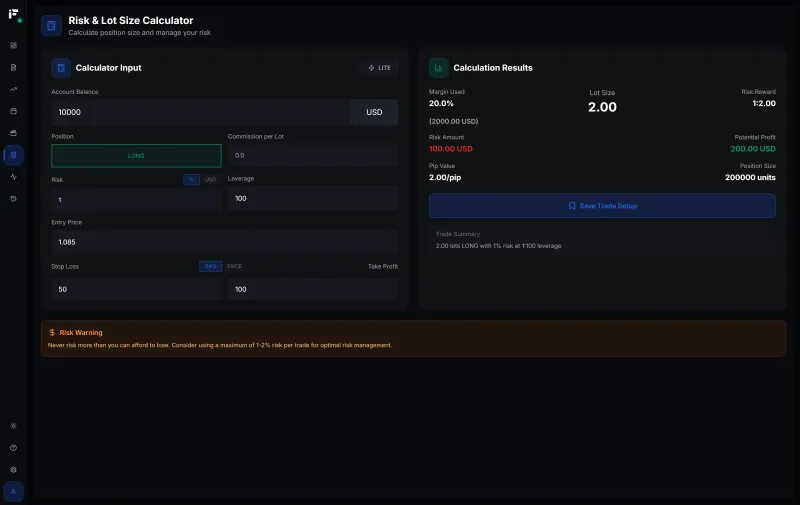
Why Risk Management is Non-Negotiable
Here's a hard truth: 90% of traders lose money. The difference between the successful 10% and everyone else? Risk management.
You can have the best trading strategy in the world, but without proper risk management, one bad trade can wipe out months of profits.
The goal of risk management isn't to avoid losses—it's to stay in the game long enough to win.
The Core Principles of Risk Management
Principle #1: Capital Preservation First
Your trading capital is your business asset. Protect it at all costs.
Think of it this way:
- Lose 10% → Need 11% to recover
- Lose 25% → Need 33% to recover
- Lose 50% → Need 100% to recover
- Lose 90% → Need 900% to recover
The math is brutal. This is why professional traders focus on not losing before focusing on winning.
Principle #2: Consistency Over Home Runs
Amateur traders look for the one trade that will make them rich. Professional traders look for consistent, repeatable edge.
| Trader Type | Focus | Result | |-------------|-------|--------| | Amateur | Big wins | Inconsistent, high drawdowns | | Professional | Small, consistent wins | Steady growth, low drawdowns |
Principle #3: Risk is Measurable, Reward is Not
You can control how much you risk. You cannot control how much you make.
This is why position sizing and stop losses are essential—they're the only parts of trading you can actually control.
The 1-2% Rule: Your Foundation
The most important rule in forex risk management:
Never risk more than 1-2% of your account on any single trade.
Why 1-2%?
With 2% risk per trade:
- 10 losing trades in a row = 18% drawdown (survivable)
- 20 losing trades in a row = 33% drawdown (challenging but recoverable)
With 10% risk per trade:
- 10 losing trades in a row = 65% drawdown (devastating)
- 20 losing trades in a row = 88% drawdown (account blown)
How to Calculate Your Risk
Example:
- Account balance: $10,000
- Risk per trade: 2%
- Dollar risk: $10,000 × 0.02 = $200 per trade
Now use this to calculate your lot size based on your stop loss distance.
Position Sizing: The Math Behind Risk
Position sizing connects your risk percentage to actual lot sizes.
The Position Sizing Formula
Lot Size = Risk Amount / (Stop Loss in Pips × Pip Value)
Practical Example
Setup:
- Account: $5,000
- Risk: 2% = $100
- Stop loss: 25 pips
- Trading EUR/USD (pip value: $10/standard lot)
Calculation:
Lot Size = $100 / (25 × $10)
Lot Size = $100 / $250
Lot Size = 0.40 standard lots
Tip: Use our Lot Size Calculator to automate this.
Understanding Stop Losses
Types of Stop Losses
1. Technical Stop Loss (Recommended)
Based on chart structure:
- Below support levels (for longs)
- Above resistance levels (for shorts)
- Beyond key swing points
Advantage: Logical placement that respects market structure.
2. ATR-Based Stop Loss
Based on Average True Range:
Stop Loss = Entry ± (ATR × Multiplier)
Common setting: 1.5-2× ATR
Advantage: Adapts to market volatility.
3. Fixed Pip Stop Loss (Not Recommended)
Always using the same pip distance regardless of market conditions.
Problem: Ignores market structure and volatility.
Stop Loss Placement Tips
✅ DO:
- Place stops beyond logical market structure
- Give the trade room to breathe
- Account for spread and slippage
❌ DON'T:
- Place stops at obvious levels (where everyone else's stops are)
- Use stops so tight they get hit by normal volatility
- Move stops closer when nervous
Risk-Reward Ratio
What is Risk-Reward?
The ratio between potential loss and potential gain:
Risk-Reward = Potential Profit / Potential Loss
Example:
- Stop loss: 30 pips ($300 risk)
- Take profit: 90 pips ($900 reward)
- Risk-Reward: 90/30 = 3:1
Why Risk-Reward Matters
With a 3:1 risk-reward ratio:
- Win 1 out of 4 trades = Break even
- Win 2 out of 4 trades = Profitable
With a 1:1 risk-reward ratio:
- Win 1 out of 4 trades = Losing money
- Need to win 51%+ to profit
This is why higher risk-reward ratios are so powerful.
Minimum Risk-Reward Requirements
| Strategy Type | Minimum R:R | Why? | |---------------|-------------|------| | Scalping | 1:1 to 1.5:1 | High win rate expected | | Day Trading | 1.5:1 to 2:1 | Balanced approach | | Swing Trading | 2:1 to 3:1 | Fewer trades, need bigger wins |
Drawdown Management
What is Drawdown?
The peak-to-trough decline in your account, measured as a percentage.
Example:
- Account peaks at $12,000
- Drops to $10,000
- Drawdown: ($12,000 - $10,000) / $12,000 = 16.7%
Maximum Drawdown Limits
Set a maximum drawdown limit for yourself:
| Trader Type | Max Drawdown | Action | |-------------|--------------|--------| | Conservative | 10% | Stop trading, review strategy | | Moderate | 20% | Reduce position sizes by 50% | | Aggressive | 30% | Stop trading, full strategy review |
Daily Loss Limits
In addition to overall drawdown limits, set daily loss limits:
Recommended:
- Daily loss limit: 3-5% of account
- If reached: Stop trading for the day
This prevents emotional "revenge trading" after losses.
Risk Management for Prop Firm Traders
Prop firms have strict risk rules. Understanding them is crucial.
Common Prop Firm Rules
FTMO:
- Maximum daily loss: 5%
- Maximum total loss: 10%
- No weekend holding (some accounts)
- Maximum relative drawdown: 4-6%
- Scaling plan based on consistency
- Challenge phase: 8-10% max drawdown
- Funded phase: 5% max drawdown
Prop Firm Risk Strategy
- Use half the allowed risk - If max daily loss is 5%, target 2.5%
- Scale in slowly - Don't max out on day one
- Track with precision - Use our Account Analysis Tools
Advanced Risk Management Techniques
The Kelly Criterion
A mathematical formula for optimal position sizing:
Kelly % = (Win Rate × Avg Win / Avg Loss) - (1 - Win Rate) / (Avg Win / Avg Loss)
Example:
- Win rate: 55%
- Average win: $150
- Average loss: $100
Kelly % = (0.55 × 1.5) - (0.45 / 1.5)
Kelly % = 0.825 - 0.30
Kelly % = 52.5%
Warning: Full Kelly is too aggressive. Most traders use "Half Kelly" (26.25% in this example).
Correlation Risk
Don't treat each trade as independent if they're correlated.
Example:
- You have 2% risk on EUR/USD long
- You want to add a GBP/USD long
- These pairs are ~80% correlated
Solution: Treat them as one trade or reduce total risk.
Multi-Timeframe Risk Management
Different risk for different timeframes:
| Timeframe | Risk per Trade | Rationale | |-----------|----------------|-----------| | Scalping | 0.5% | Many trades, compound risk | | Day Trading | 1% | Moderate frequency | | Swing Trading | 2% | Fewer trades, can handle more |
Risk Management Tools
Essential Tools
- Lot Size Calculator - Calculates proper position size
- Trading Journal - Tracks patterns in losses
- Account Analysis - Monitors drawdown metrics
Calculating Tools by Instrument
Different instruments have different characteristics:
- XAUUSD (Gold) Calculator - High volatility asset
- EURUSD Calculator - Most liquid forex pair
- NAS100 Calculator - Index with unique characteristics
Risk Management Checklist
Before every trade, ask yourself:
- [ ] Have I calculated my position size?
- [ ] Is my risk 1-2% or less?
- [ ] Is my stop loss at a logical level?
- [ ] Is my risk-reward at least 1.5:1?
- [ ] Am I under my daily loss limit?
- [ ] Does this trade fit my strategy rules?
If any answer is "no," don't take the trade.
Common Risk Management Mistakes
Mistake #1: Moving Stop Losses
Problem: Hoping the trade comes back. Solution: Accept the loss. Your stop was placed for a reason.
Mistake #2: Averaging Down
Problem: Adding to losing positions. Solution: Never add to losers. Consider adding to winners instead.
Mistake #3: Revenge Trading
Problem: Immediately entering new trades after losses. Solution: Implement a "cooling off" period after losses.
Mistake #4: Position Sizing After Wins
Problem: Getting overconfident and increasing size too quickly. Solution: Stick to your risk rules regardless of recent results.
Building a Risk Management Plan
Step 1: Define Your Parameters
- Maximum risk per trade: __%
- Maximum daily loss: __%
- Maximum total drawdown: __%
- Minimum risk-reward ratio: __:1
Step 2: Create Your Rules
Write down specific rules:
- "I will never risk more than X% per trade"
- "I will stop trading if I lose X% in a day"
- "I will reduce size by 50% after X% drawdown"
Step 3: Track Everything
Use a Trading Journal to track:
- Every trade's risk percentage
- Win/loss ratio
- Average risk-reward
- Maximum drawdown
Step 4: Review and Adjust
Monthly reviews:
- Was I consistent with my rules?
- Where did I break them?
- What adjustments are needed?
Conclusion: Risk Management = Survival
The traders who last are the ones who respect risk.
Key takeaways:
- Never risk more than 1-2% per trade
- Always use proper position sizing
- Set daily loss limits
- Track everything
- Follow your rules—no exceptions
Related Resources:
- 📊 What is a Pip? Complete Guide - Foundation for risk calculations
- 📏 Lot Size Calculator Guide - Position sizing mastery
- 📓 Trading Journal Guide - Track your performance
- 🧠 Trading Psychology Guide - Master emotions and discipline
- ⚠️ Margin Call Explained - Avoid account liquidation
- 🔬 Backtesting Guide - Test strategies before trading
- 🧮 Free Lot Size Calculator - Calculate proper size instantly
Remember: The goal isn't to never lose—it's to lose less than you win.
Emre Aktaş
Founder & Developer at Fips. Trader with 7+ years of experience in forex and crypto markets. Building tools to help traders succeed.
Related Articles

Backtesting Trading Strategies: Complete Beginner's Guide
Learn how to test your trading strategies on historical data to find an edge before risking real money
Margin Call Explained: How to Avoid and Survive It
Understand what causes margin calls, how to prevent them, and what to do if you face one in forex trading
Trading Psychology: Master Your Mindset for Consistent Profits
Learn how to control emotions, build discipline, and develop the mental edge that separates profitable traders from the rest