
The Ultimate Trading Journal Guide: Track, Analyze, and Win in 2025
Transform your trading performance with a professional trading journal. Learn what to track, how to analyze, and turn data into profits

Why 90% of Traders Fail (And How Journaling Saves You)
Here's the uncomfortable truth: Most traders repeat the same mistakes until they blow their accounts.
The difference between consistently profitable traders and everyone else? They track everything.
A trading journal is not just a log—it's a mirror that shows you exactly why you win and why you lose.
The Power of Data
Consider this:
- Traders who journal have 78% higher win rates (based on industry studies)
- Professional trading firms require detailed logging from all traders
- Every successful trader you've heard of keeps meticulous records
Still think journaling is optional?
What is a Trading Journal?
A trading journal is a systematic record of all your trades, including:
- Entry and exit details
- Trade rationale
- Screenshots
- Emotional state
- Results and lessons learned
It's your personal trading database that reveals patterns invisible in the moment.
Paper vs Digital Trading Journals
| Feature | Paper Journal | Excel/Sheets | Dedicated Software | |---------|---------------|--------------|-------------------| | Setup Time | Low | Medium | Low | | Analysis | Manual, slow | Manual, formulas | Automatic | | Screenshots | Difficult | Possible | Easy | | Pattern Detection | Manual | Manual | Automated | | MT4/MT5 Sync | No | No | Yes | | Mobile Access | No | Limited | Full |
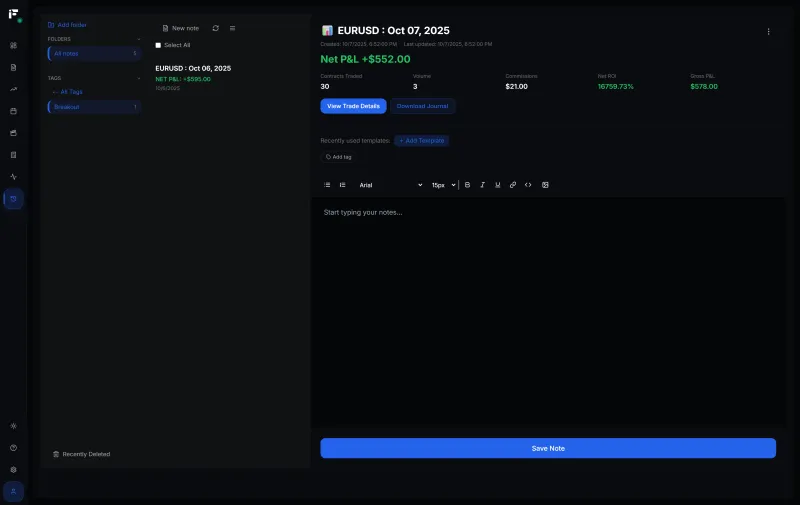
Our recommendation: Use dedicated trading journal software like Fips Trading Journal for automatic analysis and MT4/MT5 sync.
What to Track in Your Trading Journal
Essential Data (Track Every Trade)
Trade Basics:
- Date and time of entry
- Date and time of exit
- Currency pair or asset
- Position type (Long/Short)
- Entry price
- Exit price
- Position size (lots)
- Profit/loss in $ and pips
Risk Data:
- Stop loss level
- Take profit level
- Risk amount ($)
- Risk percentage (%)
- Actual risk-reward achieved
Important Context (Track for Analysis)
Setup Information:
- Strategy/setup name
- Timeframe used
- Market conditions (trending/ranging)
- Session (London/NY/Asian)
Execution Quality:
- Did you follow your plan?
- Entry quality (1-5)
- Exit quality (1-5)
- Was stop too tight/wide?
Advanced Tracking (For Serious Traders)
Psychological Data:
- Emotional state before trade (1-5)
- Emotional state after trade (1-5)
- Confidence level
- Any external factors (tired, distracted, etc.)
Screenshots:
- Chart at entry (marked with entry point)
- Chart at exit (marked with exit point)
- Higher timeframe context
How to Analyze Your Trading Journal
Weekly Review Process (30 minutes)
Every Sunday, analyze your week:
Step 1: Calculate Key Metrics
Win Rate = Winning Trades / Total Trades × 100
Average Win = Total Profit / Number of Wins
Average Loss = Total Loss / Number of Losses
Profit Factor = Gross Profit / Gross Loss
Expectancy = (Win Rate × Avg Win) - (Loss Rate × Avg Loss)
Step 2: Identify Patterns
- Which setups performed best?
- Which sessions were most profitable?
- Which pairs gave the most trouble?
- Were there common mistakes?
Step 3: Create Action Items
- "Focus on setup X (highest win rate)"
- "Avoid trading pair Y (consistent losses)"
- "Don't trade during session Z (poor results)"
Monthly Deep Dive (2 hours)
Review Categories:
- Best Trades - What made them work?
- Worst Trades - What went wrong?
- Missed Opportunities - Setups you didn't take that worked
- Rule Violations - How often and why?
Key Questions:
- Is my strategy actually profitable over 30+ trades?
- Am I improving month over month?
- What's my biggest leak (source of losses)?
- Which improvements had the most impact?
Quarterly Strategy Assessment
Every 3 months:
- Calculate overall performance metrics
- Compare to previous quarters
- Decide if strategy needs major changes
- Set goals for next quarter
Building a Trading Journal Routine
Pre-Trade (2 minutes)
Before every trade:
- Write down your trade rationale
- Note your stop loss and target
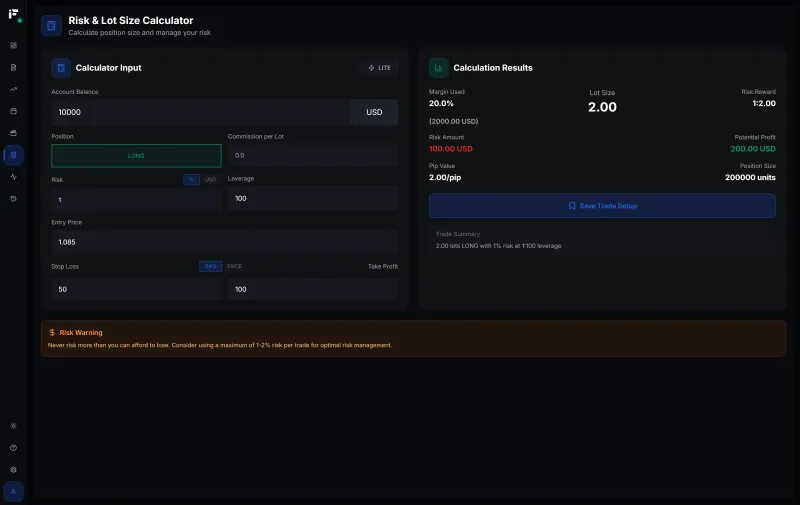
- Calculate position size using Lot Size Calculator
- Rate your emotional state (1-5)
Post-Trade (5 minutes)
After every trade closes:
- Record the outcome
- Take exit screenshot
- Note any deviations from plan
- Write one lesson learned
End of Day (10 minutes)
Before closing your platform:
- Review all trades taken today
- Calculate daily P/L
- Note if you hit any loss limits
- Set intentions for tomorrow
Trading Journal Metrics That Matter
The Core Four
1. Win Rate
What it tells you: How often you're right.
Win Rate = Winners / Total Trades
- Scalping: 60-80% expected
- Day Trading: 45-60% expected
- Swing Trading: 35-50% expected
2. Risk-Reward Ratio
What it tells you: How big your wins are vs losses.
R:R = Average Win / Average Loss
- 1:1 = Needs 50%+ win rate to profit
- 2:1 = Profits at 34% win rate
- 3:1 = Profits at 25% win rate
3. Expectancy
What it tells you: Average $ expected per trade.
Expectancy = (Win% × Avg Win) - (Loss% × Avg Loss)
Positive = Profitable strategy Negative = Losing strategy
4. Profit Factor
What it tells you: Gross profitability ratio.
Profit Factor = Gross Profit / Gross Loss
- Below 1 = Losing money
- 1-1.5 = Marginally profitable
- 1.5-2 = Good
- Above 2 = Excellent
Secondary Metrics
Maximum Drawdown
- Largest peak-to-trough decline
- Should be below 20% for most traders
Trade Frequency
- Trades per day/week
- Are you over-trading?
Average Trade Duration
- Matches your strategy style?
Win/Loss Streaks
- Longest winning streak
- Longest losing streak
Common Journaling Mistakes
Mistake #1: Only Logging Winners
Problem: Selection bias hides your real performance.
Solution: Log every trade, especially the losses. Losses teach more than wins.
Mistake #2: Vague Notes
Bad: "Took a trade, it worked" Good: "H4 bullish engulfing at 1.0850 support, entered on M15 retest, 2R target hit in London session"
Solution: Be specific enough that future-you can learn from it.
Mistake #3: Logging Without Analyzing
Problem: Data without analysis is just a diary.
Solution: Schedule weekly reviews. No excuses.
Mistake #4: Not Tracking Emotions
Problem: Most trading failures are psychological, not strategic.
Solution: Track your emotional state before and after trades.
Mistake #5: Giving Up After 2 Weeks
Problem: The value compounds over time.
Solution: Commit to 90 days. By then, it's a habit.
Trading Journal Templates
Simple Trade Log Template
Date: [DATE]
Pair: [PAIR]
Direction: [LONG/SHORT]
Entry: [PRICE]
Stop: [PRICE]
Target: [PRICE]
Size: [LOTS]
Result: [+/- $]
Notes: [WHY YOU TOOK IT, WHAT HAPPENED]
Advanced Trade Analysis Template
== TRADE ENTRY ==
Date/Time: [DATE TIME]
Pair: [PAIR]
Setup: [SETUP NAME]
Timeframe: [TF]
Direction: [LONG/SHORT]
Entry Price: [PRICE]
Stop Loss: [PRICE] ([PIPS])
Take Profit: [PRICE] ([PIPS])
Risk: $[AMOUNT] ([%] of account)
R:R Planned: [X:X]
Confidence: [1-5]
Emotion: [1-5]
Rationale: [WHY ARE YOU TAKING THIS TRADE?]

== TRADE EXIT ==
Exit Date/Time: [DATE TIME]
Exit Price: [PRICE]
Result: [+/-] [PIPS] = $[AMOUNT]
R Multiple: [XR]
Followed Plan: [YES/NO]
What Worked: [NOTES]
What Didn't: [NOTES]
Lesson: [ONE KEY TAKEAWAY]
Using Trading Journal for Prop Firm Challenges
Prop firms require discipline. Your journal proves it.
Track These for Prop Firms
Daily:
- Starting equity
- Ending equity
- Daily P/L ($ and %)
- Distance from max daily loss
For Each Trade:
- Risk percentage used
- Running drawdown
- Lots used vs allowed
Prop Firm Journal Checklist
- [ ] Am I under max daily loss limit?
- [ ] Am I under max overall drawdown?
- [ ] Are my position sizes within limits?
- [ ] Did I follow prop firm rules today?
Related: Calculate proper sizes for FTMO, The5ers, and Funded Next.
Fips Trading Journal Features
Our Professional Trading Journal offers:
✅ Automatic MT4/MT5 Trade Import - No manual entry ✅ One-Click Screenshots - Attach charts instantly ✅ Performance Analytics - Automatic metric calculation ✅ Pattern Detection - AI finds your winning/losing patterns ✅ Daily/Weekly/Monthly Reports - Progress tracking ✅ Export to PDF - For accountability partners or coaches ✅ Multi-Account Support - Track all your accounts
Getting Started with Fips
- Sign up for Fips (free tier available)
- Connect your MT4/MT5 account
- Trades sync automatically
- Add notes and screenshots
- Review your automatic reports
Your 30-Day Trading Journal Challenge
Week 1: Build the Habit
- Log every trade same day
- Include basic info only
- Don't analyze yet
Week 2: Add Context
- Include screenshots
- Rate emotional state
- Note rationale briefly
Week 3: Start Analyzing
- Calculate weekly metrics
- Identify one pattern
- Set one improvement goal
Week 4: Full Integration
- Complete pre/post trade routine
- Weekly review session
- Create next month's action plan
By day 30, journaling will be automatic. And your trading will never be the same.
Frequently Asked Questions
How long should I spend journaling each day?
- Pre-trade: 2 minutes
- Post-trade: 5 minutes per trade
- End of day: 10 minutes
Most traders journal 15-30 minutes daily.
Can I use Excel for my trading journal?
Yes, but you'll spend more time on data entry than analysis. Dedicated software like Fips automates the boring parts so you focus on insights.
What's the minimum sample size for analysis?
30 trades minimum for basic patterns. 100 trades for reliable statistical conclusions.
Should I journal demo trades?
Yes. During learning, demo trades build the habit. Just mark them clearly in your journal.
Next Steps
- Try Fips Trading Journal – Start tracking today
- Calculate Your Position Sizes – Proper risk management
- Learn Risk Management – Protect your capital
Related Resources:
- 📏 What is a Pip? Guide – Learn pip basics
- 🛡️ Risk Management Guide – Manage drawdowns
- 📅 Economic Calendar Guide – Trade the news
- 🧠 Trading Psychology Guide – Master your emotions
- ⚠️ Margin Call Explained – Protect your account
- 🔬 Backtesting Guide – Test before you invest
- 🧮 Lot Size Calculator – Size properly
Remember: The trade you don't log is the lesson you don't learn. Start journaling today.
Emre Aktaş
Founder & Developer at Fips. Trader with 7+ years of experience in forex and crypto markets. Building tools to help traders succeed.
Related Articles

Backtesting Trading Strategies: Complete Beginner's Guide
Learn how to test your trading strategies on historical data to find an edge before risking real money
Margin Call Explained: How to Avoid and Survive It
Understand what causes margin calls, how to prevent them, and what to do if you face one in forex trading
Trading Psychology: Master Your Mindset for Consistent Profits
Learn how to control emotions, build discipline, and develop the mental edge that separates profitable traders from the rest